Meaning of Money Part 3.
How money is created


    a. Object (metal) based currencies
    b. Nominal currencies
    c. Fiat currencies


a. Object (metal) based currencies

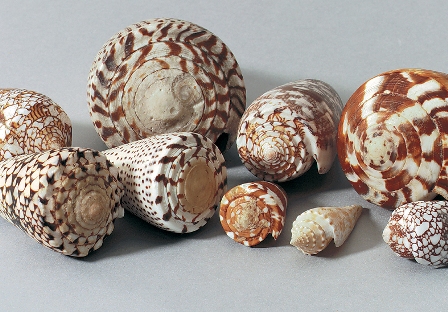
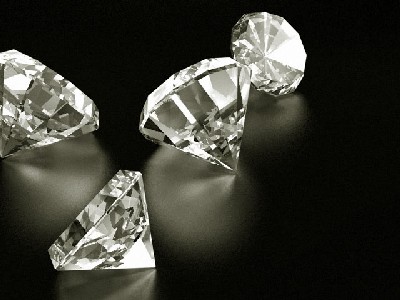
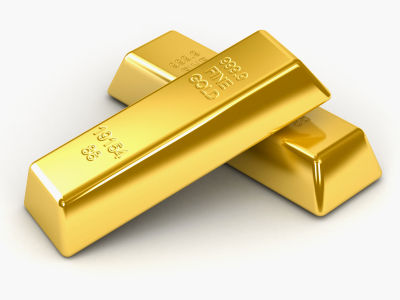
One of predominant theories about money is that it should be based upon some rare physical objects such as seashells or diamonds. The most often named object is gold. It is seldom suggested - especially in the case of gold - that the physical object itself be used as the currency because if that were the case the commodity might depreciate through wear or in the case of gold it was subject to 'sweating' where a small amount was removed by intermediate users. Consequently the money would therefore be gold 'certificates' and it is the certificates rather than the gold that would be moved about.

How much gold a certificate might be redeemed for might be fixed and it might take a great number of certificates to redeem a single ounce of gold. With a limited supply of gold, and great numbers of certificates being printed for each ounce, the availability of gold for other purposes would become problematical. The social question would become whether there was 'value of gold' for other than currency. But that issue aside there are much greater social issues because it becomes a question of 'who' has the gold. That is to say - 'entitlement' to the gold and equitable distribution of that entitlement. With certificates there are even issues as to who physically has the gold and as to whether or not it is actually there.

If some country of group happens to not have gold then by what means can they initially obtain money? One could say that they might develop goods and services to trade for the gold, but then they are just out of luck at the outset. From the 'get go' the question is who has the gold and is it just that they do. Those who possess the gold may not be concerned about justice and some may argue that concerns about justice are not the proper purvue of a discussion about the nature of money.

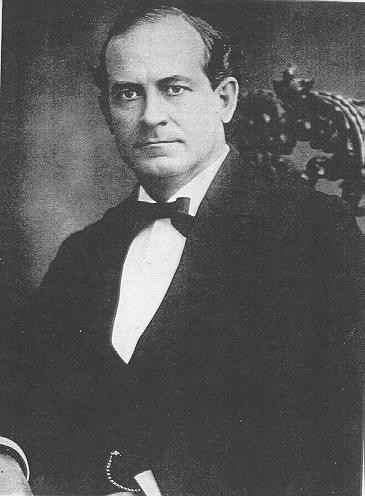
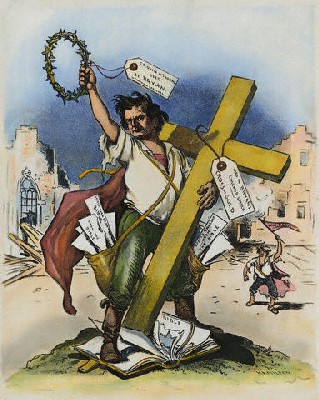
However, I will stand with the saying of William Jennings Bryan who said - "you shall not crucify mankind upon a cross of gold.� Just because a country or society doesn't happen to have gold, or a means to get it, doesn't mean that they should starve. In actuality Bryan was a bi-metalist. He just wanted the free coinage of silver - and not of gold alone. That would just move my concern down one step. Who has the silver and gold - and how did they get it?


Seashells


Diamonds


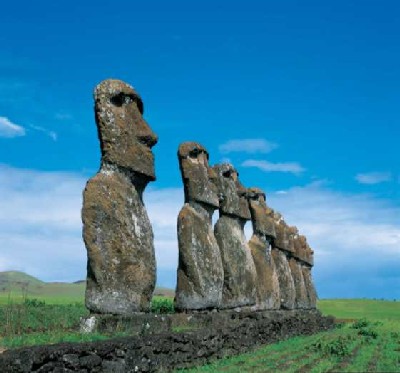
Speculated as the money used on Easter Island


William Jennings Bryan (March 19, 1860 � July 26, 1925)


"you shall not crucify mankind upon a cross of gold.� - William Jennings Bryan


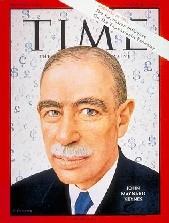
John Maynard Keynes
(5 June 1883 � 21 April 1946)

"In truth,
the gold standard is already
a barbarous relic."

Those who so strongly advocate gold backed currencies should ask themselves several questions:

    a. Who is it that owns the gold? Ownership of gold bullion is concentrated in the hands of a very few individuals in the world. In the 'capitalist / money' system those few people who own most of the gold - would have all money based on gold - or fiat currency that they control.

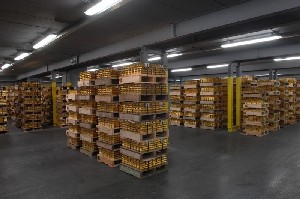
    b. What is it that you see useful when you look at the pictures of the storage of gold bars? How do the stacks of gold bars perform any better function than did the large stone carvings on Easter Island?

    c. What is it about not having the ownership of gold that should make the Punjabi farmers so ashamed that they commit suicide - or that should prevent a society from employing its university graduates.

Currency / money should not be viewed as an end in itself. It should be a social tool for the efficient functioning of economies to assure that all the members are living productive lives that contribute to the society and enhance the material and spiritual fulfillment of each of the society members to the best of their ability. With fiat money, it is much easier to assure that there is money to achieve these goals.

b. Nominal currencies


Rather than silver or gold or some other physical object there are those who have suggested that money be based upon energy, labor, service, or some other nominal basis.

There have been a great many attempts by various associations and bartering organizations to create supplementary money of this type, giving credit where energy, some product, or labor or service is performed. These systems have been generally unsuccessful because a more adequate monetary system was available even if it was performing poorly - still people preferred a currency that traded more broadly.

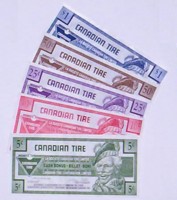
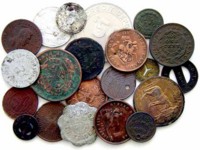
Actually, anyone can create money. The problem is getting others to accept it. It is illegal, and called counterfeiting, to make someone else's money - but there are many specialized forms such as coupons, and tokens as pictured here.

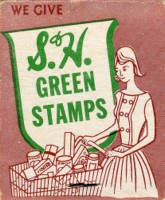
In Canada there is a famous type of money called 'Canadian Tire Money' that is printed by a private company. This bonus (not bogus) 'monopoly type' of money is not the sole example. Saving S&H Green Stamps was a popular activity when I was a boy.

Some towns and firms made their own tokens when there was a shortage of money. There were also wooden nickels. A merchant leaving his clerk in charge of the store might caution - "Dont' take any wooden nickels."


------

c. Fiat currencies

Fiat currencies are currencies created without any backing except the authority of the issuing authority. If issued by a source other than the issuing authority then that is considered counterfeiting.

Bi-metalists and other physical object oriented monetarists, feel that there needs to be some limiting factor to the creation of money - otherwise it can be just created limitlessly by the creating authority. Much of their discussion revolves around (inflation/deflation) and the money becoming valueless - with trillions upon trillions lost - but may I remind you that the real assets (physical, human, spiritual) remain. What is really lost is the trillions of dollars of human services, represented by the lost income and lost wages in the lives of workers, when there is not full employment caused by the lack of money.

Most all the shouting in monetary discussions is about this meaningless veil of the collapse of fiat currencies/money. The search for the holy grail of a money that will remain infinitely stable is like the search for a perpetual motion machine. All human built systems eventually fail.

If one has confidence in the value of gold or diamonds or any other commodity as a store of wealth and value - then let them by all means buy gold. However, to allow the possessors of gold to control the supply of money or the liquidity necessary for a viable and vital economy is social insanity.

The real issue for any currency should be how to continue or restore the full employment of the real factors of production and how to equitably replace a currency that fails.

Fiat money is not just printed paper and in point of fact is usually the marks on an accounting book or the blips in a computer memory. Fiat currencies are the most efficient to use to initiate and accelerate economic activity. The real issues are 'who is the authority' that creates them and by what 'principles' should they create money. That is the subject that we shall turn to next.


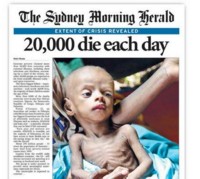
      Currency manipulators were able to create such extremes of wealth and poverty that children starved to death while other people never worked but had environmentally non-sustainable ski slopes in the middle of the desert.

------

Note by Bruce:

Disappearance of Money

Money is a very useful thing to an economy. For an economy we might almost say that it as essential as the air that we breathe or as water is to a fish. Still, if as by magic - all the money in the world were to suddenly vanish it would be just an administrative act needed to replace it and the economy could then again function as well as ever so long as the REAL factors of production - discussed previously - remained. On the other hand if the REAL factors of production were to be destroyed (by war or some other means) then the economy itself would vanish no matter how much money remained.

Note by Bruce:

Disappearance of Gold

What was said in the box above about the disappearance of money applies even more to the disappearance of gold. Should all the gold in the world suddenly by magic vanish then except for some people missing fillings in their teeth, or some electronic circuits failing because of the disappearance of connections, and some diamonds in jewellery suddenly dropping on the floor - there would be no real loss to the world.

But once again - it would truly be tragic to the world if the REAL factors of production were to disappear or be destroyed.

There is the story of a Congressman who wanted to pass a bill that Congress go down to Ft. Knox to determine if the gold was still really there. A wiser Congressman replied - "It really doesn't make any difference, and if it isn't, you don't want to know."


Click here to:

go back to the Index

or to go on to Part 4